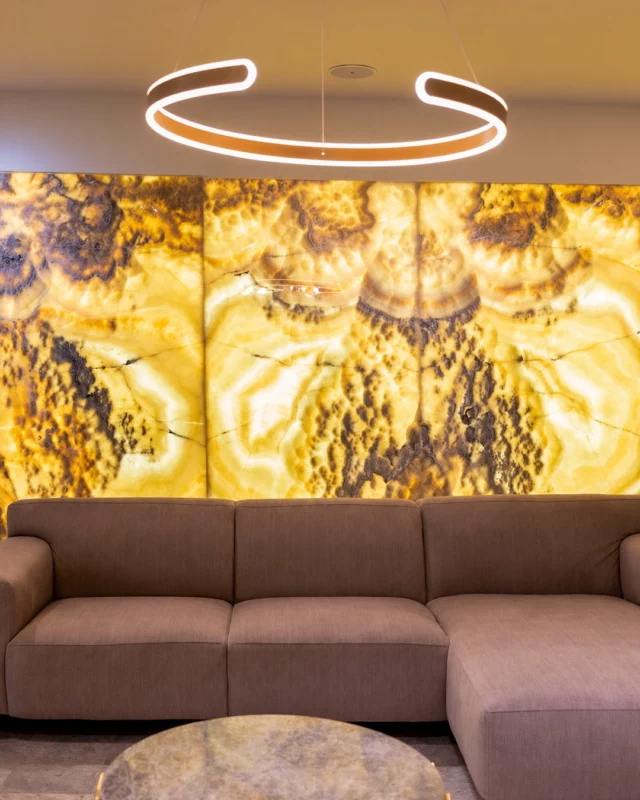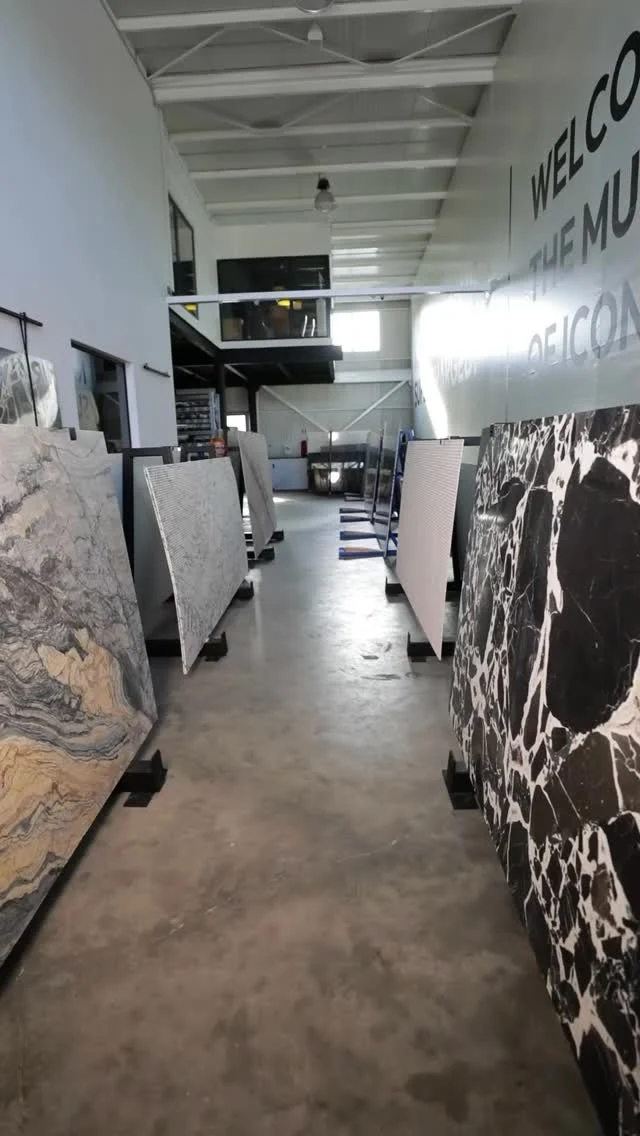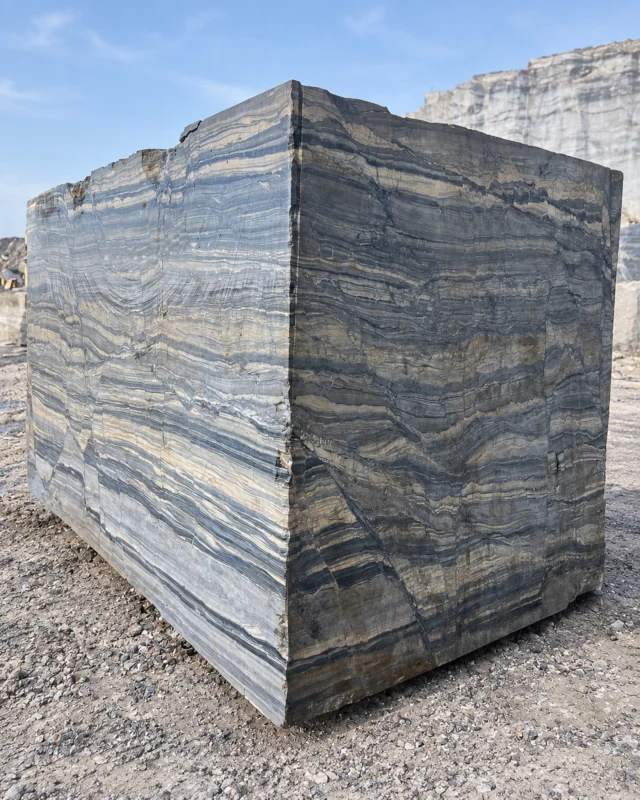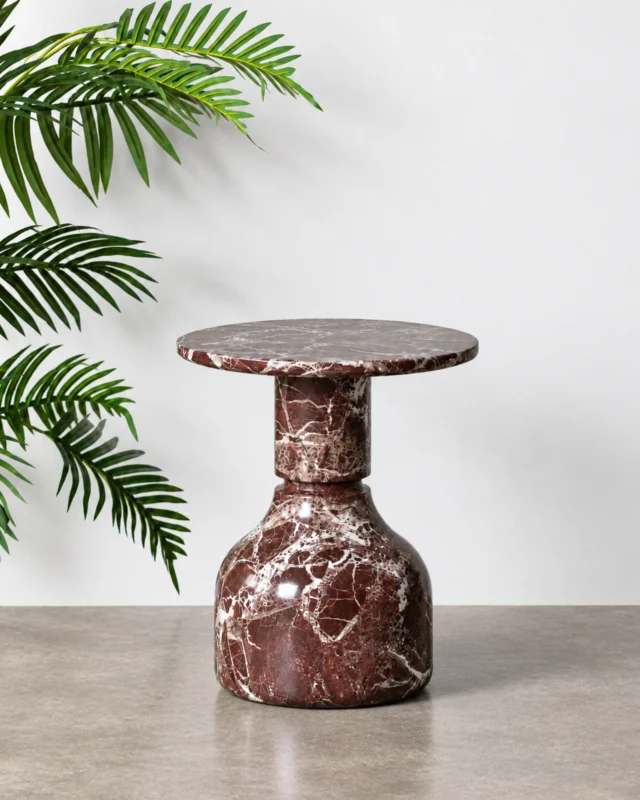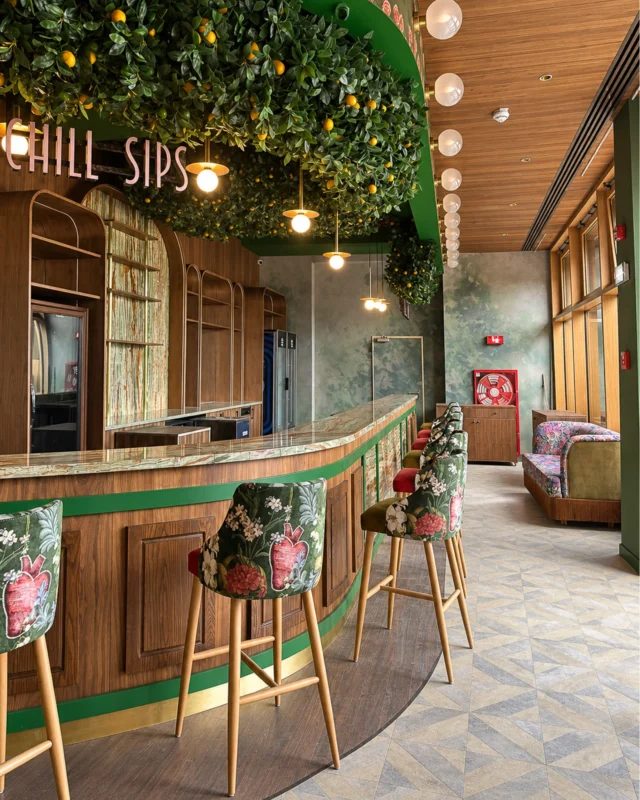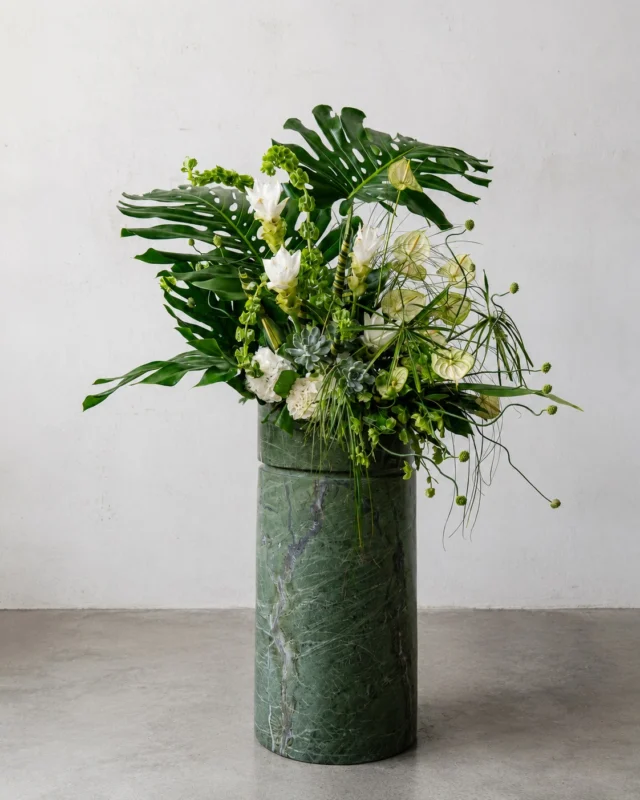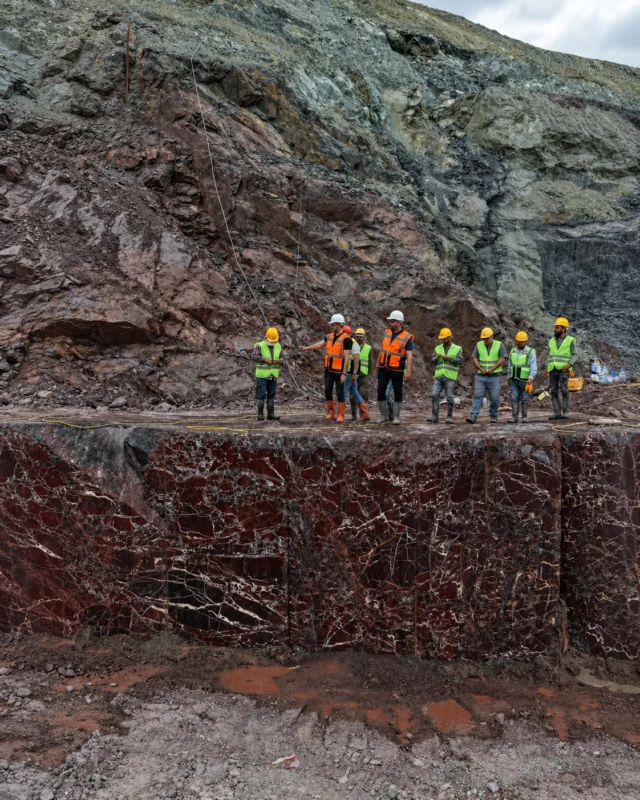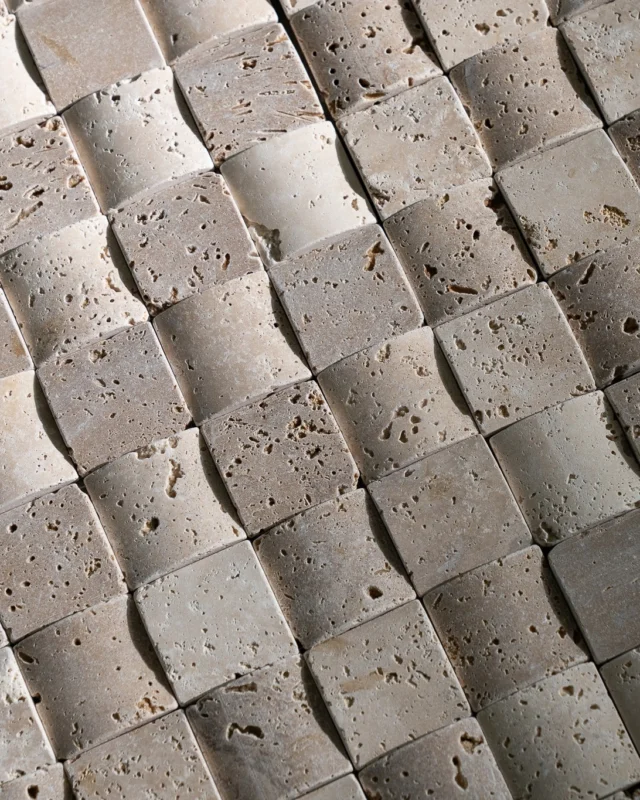



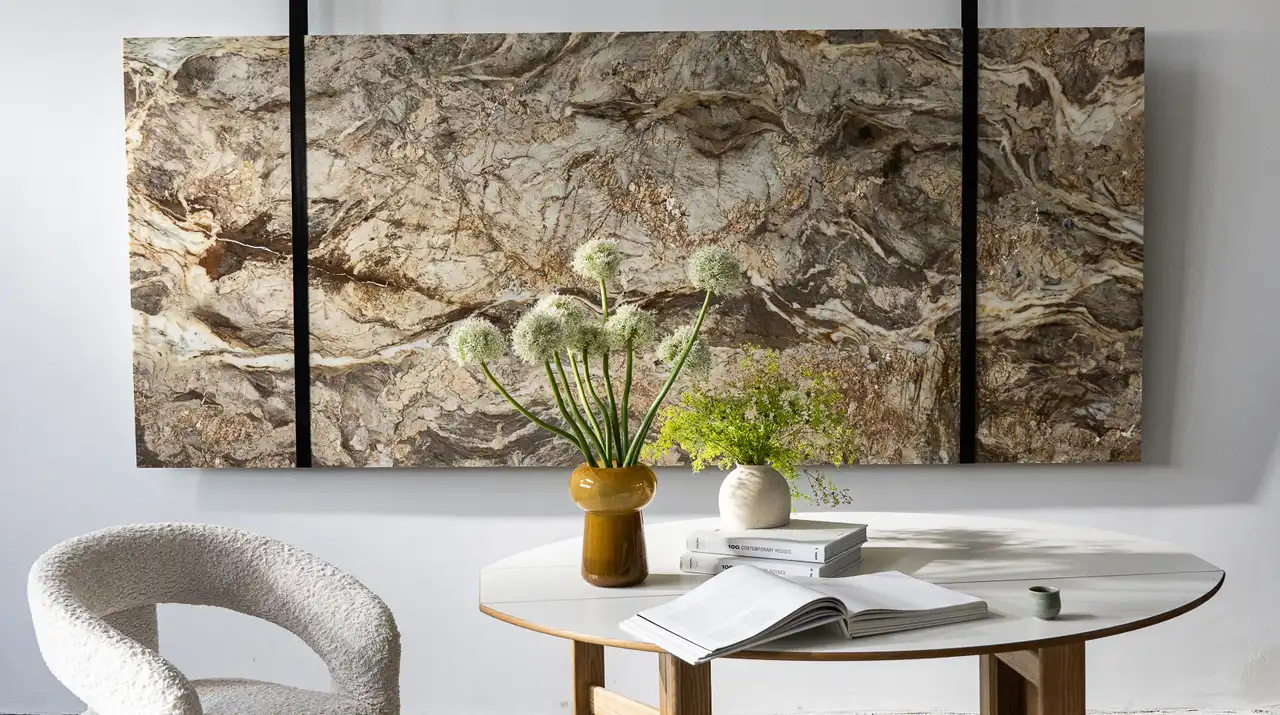
A slab is a large sheet of stone cut directly from the block, usually 2 or 3 cm thick and around 3 × 2 m. Unlike calibrated catalogue tiles, every slab has its own pattern. That is why, for worktops, feature walls or bookmatch, you do not just specify the name of the stone, but the exact slab, by block and sequence number.
A 10 × 10 cm sample shows you the colour and the finish. It does not show you where the main vein runs, how large the calm area of the slab is, or how the pattern continues across the joint. For that, you need to see the whole slab.
We have been working with natural stone since 2007, with exclusive partner factories, CNC cutting and our own installation team. The guide below brings together the questions architects and designers ask us most often when choosing a slab.
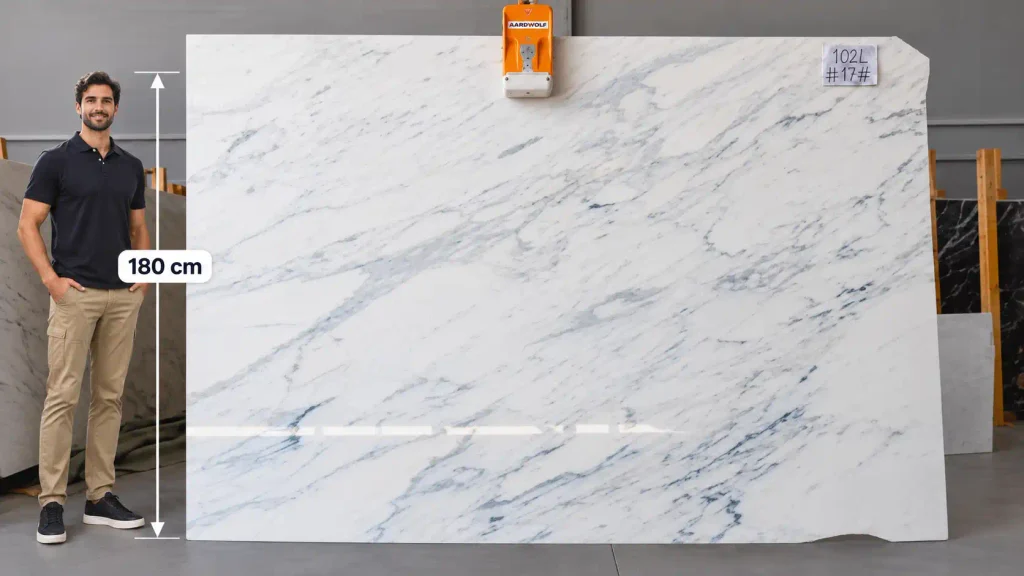
What is a slab and how is it different from a calibrated tile?
A slab is cut from the block at the largest size the block allows. A calibrated tile is cut to a fixed format (60 × 60, 120 × 60 etc.) and chosen from a sample. The difference matters in a project: with a slab, the pattern becomes part of the composition; with a calibrated tile, it repeats across the whole surface.
| Slab | Calibrated tile | |
|---|---|---|
| Typical size | approx. 2.6–3.2 × 1.6–2.0 m | fixed formats, usually under 1.2 m |
| Thickness | 2 cm or 3 cm | 1–2 cm |
| Pattern | unique to each slab | variation within the batch |
| How it is chosen | the exact slab, by block and sequence | by name and sample |
| Suitable for | worktops, islands, feature walls, bookmatch, receptions | floors and cladding over large areas |
Every slab carries a label with the block number and its position in the cutting sequence. Any joint with a continuous pattern relies on this information. See our selection of marble slabs.
Why choose the slab before finalising the drawings?
Because the position of the veins decides where the joints fall, not the other way round. If you set out the wall or the island on the real size of the slab, you can keep the main vein on the visible face, avoid a joint through the middle of a strong pattern and reduce waste.
In practice, a few decisions are easier to make once you have seen the slab:
- Vein direction on the island and on waterfall ends. The vein can “flow” from the top down the side only if the cuts are planned from the same slab.
- Joint position on bathroom walls. If you divide the wall according to the slab, the pattern stays whole where it matters.
- Cut-outs (basin, hob, sockets). Where possible, move them away from the most valuable part of the pattern.
- Number of slabs. You work it out from the pattern, not just from the surface area (see the calculation below).
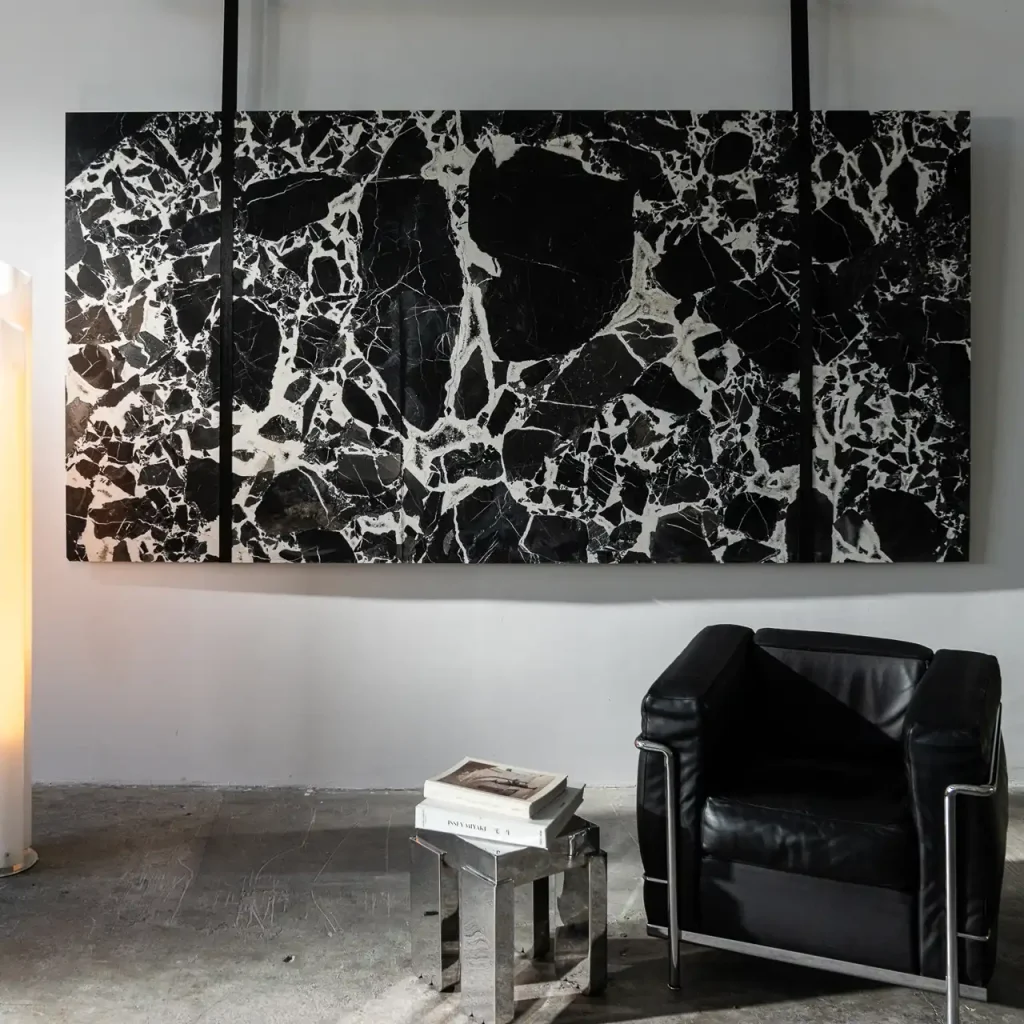
How to assess a slab in the showroom: 6 points to check
- From 4–5 metres. Note what you see first: movement, contrast or colour. That is how the slab will be perceived in the space.
- Up close. Look for natural fissures, resin-filled areas and the reinforcement mesh on the back. They are normal in many stones, but it matters where they fall in relation to your pieces.
- Edges and usable area. Slabs have irregular edges. Calculate on the net usable size, not the gross size.
- The finish. The same material looks different polished, honed (matt) or brushed. Polished brings out contrast and reflections, while honed softens the colour. If the project calls for a different finish from the slab on display, ask for a test on the same stone.
- The light. Look at the slab in daylight and in the warm light planned for the project. Some white marbles shift towards grey or cream depending on the colour temperature.
- The numbers. Photograph the label (block and sequence) and ask how many consecutive slabs are left from the same block. For large surfaces or bookmatch, this is the most important information.
Bookmatch, slip match or quad match: which type of match should you choose?
Bookmatch means two consecutive slabs from the same block, laid like the pages of an open book, so that the pattern mirrors across the shared joint. It is the right match for feature walls, bed headboards, receptions or bar fronts.
| Match | What it looks like | Slabs needed |
|---|---|---|
| Bookmatch | mirrored pattern across the joint | 2 consecutive slabs |
| Quad match (4-way) | mirrored horizontally and vertically, with a clear centre | 4 consecutive slabs |
| Slip match | slabs repeat side by side, without mirroring | 2 or more consecutive |
| Open / random | slabs from the same batch, no pattern continuity | same batch |
Three details worth knowing before you order:
- Bookmatch slabs are polished on opposite faces. The second slab is turned over, so its visible face is the one that was facing the first slab. Say from the start that you want bookmatch, so the slabs are prepared correctly.
- The mirroring is not mathematically perfect. The saw blade takes a few millimetres between slabs, so the pattern shifts slightly. With fine veins you cannot see it; with very thick veins you may notice it.
- No consecutive slabs, no bookmatch. If you like a block for a large project, reserve the slabs together.
Backlit onyx: what the designer needs to know
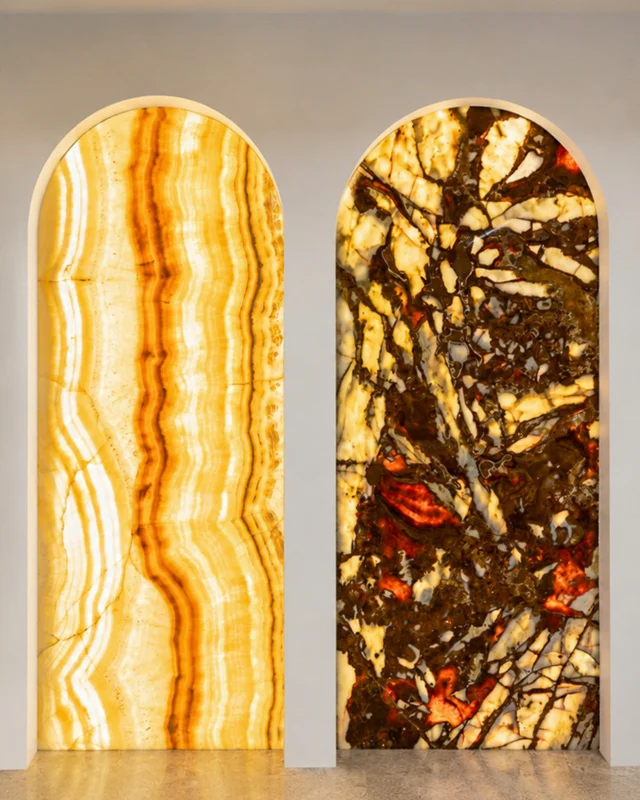
The onyx used in architecture is a banded limestone, formed by deposition in caves and springs. Many slabs are translucent, and with light behind them the structure becomes visible in depth. However, it is softer and more sensitive than marble, so it belongs first and foremost on vertical and decorative surfaces. See our onyx range.
- Where it works: bar fronts, reception walls, bathroom niches, decorative panels, low-use counters.
- Where it is not recommended: high-traffic floors, kitchen worktops. It scratches and stains easily on contact with acids (lemon, vinegar, wine).
- Translucency varies from slab to slab. Choose with the slab backlit, in the showroom. A photograph does not show the depth.
- The technical cavity is part of the design. You need a distance between the light source and the stone to diffuse the light evenly. Also plan access for LED maintenance.
- Colour temperature changes the stone. The same onyx looks warmer at 3000K and cooler at 4000K. Test before you fix the specification.
- Reinforcement and thickness. For backlit panels, we reinforce the onyx on the back with resin and mesh. Agree the thickness and fixing details with us from the design stage.

Marble slab or XL porcelain slab: which should you choose?
Large-format porcelain slabs now come close to the size of a natural slab. Florim, for example, produces its Magnum collection up to 160 × 320 cm, in 6, 12 and 20 mm thicknesses. The difference is no longer about format. It is about the pattern, the edges and how the material ages.
| Natural slab | XL porcelain slab | |
|---|---|---|
| Pattern | unique to each slab | digitally printed, with a limited number of graphic faces that repeat |
| Vein on the edge | runs through the full thickness | usually on the surface only; the edge is solved with a 45° mitre |
| Bookmatch | from consecutive slabs of the same block | only in collections with printed bookmatch pairs |
| Typical thicknesses | 2 and 3 cm | 6, 12, 20 mm |
| Approximate weight | approx. 54 kg/m² at 2 cm | approx. 14–15 kg/m² at 6 mm |
| Acids and stains | marble is sensitive and needs treatment | very low porosity, high resistance |
| Repairs | can be re-polished and restored | a chip on the edge stays visible |
| Installation | stable substrate, fixing suited to the weight | very flat substrate, full-coverage adhesive (including on the back of the slab), special handling equipment |
When we recommend XL porcelain: surfaces repeated across several spaces (hotel chains, retail), heavy-use kitchen worktops, rainscreen façades, areas where the client does not accept patina.
When we recommend a natural slab: feature walls, receptions, master bathrooms, bookmatch, projects where the piece has to be unique and restorable 20 years from now.
PIATRAONLINE works with both: natural slabs and sintered stone. We will tell you honestly which one suits your project.

How many slabs do you need? A quick calculation
Start from the usable size of the slab, not the gross size, and add a margin for matching the pattern. As a guide, waste is 15–20% for cladding without continuity and can exceed 30% for bookmatch or quad match, because the pattern dictates the cuts.
Example: for a 3.0 × 2.6 m wall in bookmatch, with slabs of approx. 3.0 × 1.8 m installed vertically, you need two consecutive slabs. From each one you use a width of 1.5 m, with the mirrored joint in the middle of the wall. A second wall in the same pattern needs another two consecutive slabs from the same block.
How is the price of a slab calculated?
With a slab, you pay for the whole slab, not just the square metres that end up in the project. We do not sell part slabs. The final price depends on the stone, thickness, finish, the number of consecutive slabs required, the complexity of the CNC cutting and the installation. That is why two projects with the same surface area can cost different amounts: a bookmatch uses more slabs than simple cladding. For an accurate estimate, send us the drawings and the surface areas.
How do you care for marble and onyx?
Marble and onyx are sensitive to acids: lemon, vinegar, wine or aggressive cleaners can leave dull marks on a polished surface. We recommend a water- and oil-repellent treatment after installation, refreshed periodically, and daily cleaning with a pH-neutral cleaner. [LTP](link LTP range) cleaning, sealing and care products are available from PIATRAONLINE, including in trade quantities.
Sample specification for the tender documents
| Material: [name] marble · Slabs from block no. … sequence … – … · Thickness 2 cm · Polished / honed finish · Bookmatch on the wall axis · Edge [type] · Water- and oil-repellent treatment after installation · Approval sample before cutting |
How to reserve a slab at PIATRAONLINE
- Selection. Choose the slab in the Slab Gallery or directly in the showroom, in Bucharest or Timișoara.
- Slab sheet. You receive the name, usable dimensions, thickness, finish, block number and sequence, plus photographs.
- Reservation. Once paid, the slab is held for your project for up to 3 months, while the final dimensions are confirmed.
- Cutting plan. We draw the cutting plan on the photograph of your slab and agree together where the cuts fall.
- Survey, CNC and installation. We take the site measurements, cut in our partner factories and install with our own team. Lead times: an uncut slab is delivered within 2–3 weeks at most, a cut slab within 4–6 weeks.
Architects and designers receive free samples of the materials specified in their project.
Working on a project? Book an online consultation with our team. We will prepare the slabs and show them to you live on camera. You are also welcome to visit our showrooms in Bucharest and Timișoara.

Frequently asked questions
What is a marble slab?
A marble slab is a large sheet of marble cut directly from the block, usually 2 or 3 cm thick and around 3 × 2 m. Every slab has a unique pattern, so for projects with continuity you choose the exact slab, not just the type of marble
How thick are marble slabs?
The most common thicknesses are 2 cm and 3 cm. 2 cm is usually used for wall cladding and for worktops with built-up edges, 3 cm for worktops without a built-up edge. The right thickness depends on the application, the spans and the edge.
Do two slabs of the same marble look the same?
No. Even slabs from the same block differ in pattern and shade. For large surfaces, choose slabs from the same batch; for a continuous pattern, consecutive slabs from the same block.
What does bookmatch mean and how many slabs do I need?
Bookmatch means two consecutive slabs from the same block, laid so that the pattern mirrors across the joint. You need at least two consecutive slabs, and four for quad match. The slabs are polished on opposite faces, so bookmatch must be requested when you order.
Marble slab or XL porcelain slab?
A natural slab has a unique pattern, a vein that continues on the edge, and can be restored. An XL porcelain slab has very low porosity and high stain resistance, but the printed pattern repeats and chips on the edge stay visible. The choice depends on the application and on how important uniqueness is.
Can onyx be used in a kitchen or on a floor?
It is not recommended. Onyx is softer than marble and sensitive to scratches and acids. It is used mainly on vertical and decorative surfaces: bars, reception walls, niches, backlit panels.
Can I reserve a specific slab for my project?
Yes. You choose the slab in the Slab Gallery or in the showroom, receive its sheet with the block and sequence number, and once paid the slab stays reserved for your project for up to 3 months.
How long does it take from choosing the slab to installation?
As a guide, an uncut slab is delivered within 2–3 weeks at most and a cut slab within 4–6 weeks, from confirmation of the measurements.
Do I get samples as an architect or designer?
Yes. PIATRAONLINE sends architects and designers free samples of the materials specified in their project.