


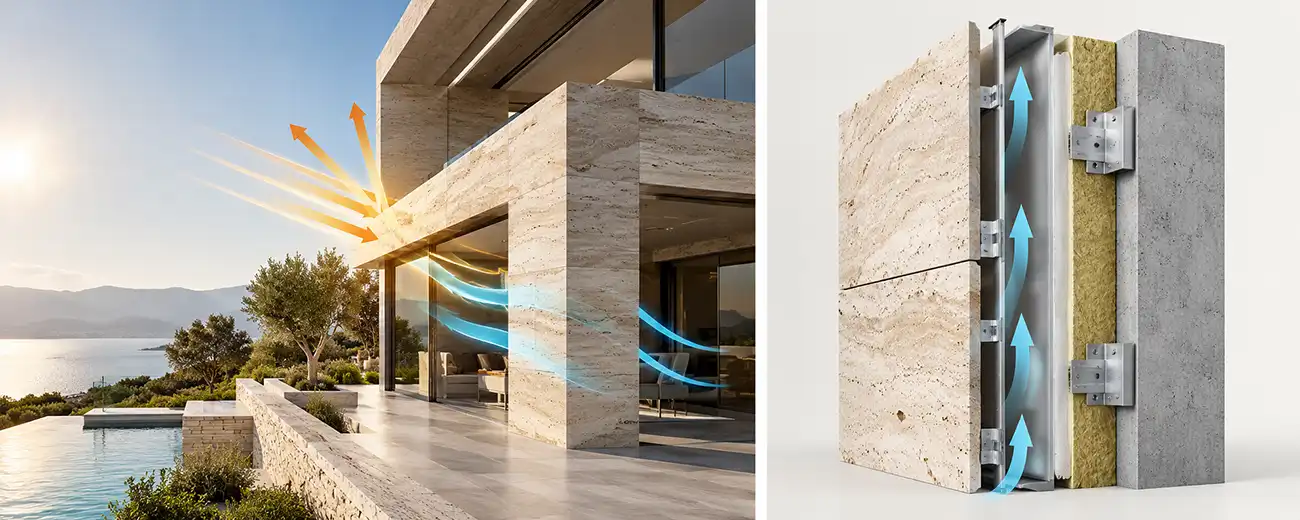
Natural stone supports thermal comfort through thermal mass: it stores heat and releases it slowly, which reduces temperature swings indoors. However, it is not an insulating material and does not replace the thermal insulation of the building envelope. The greatest benefit comes from the right combination: stone on the inside, in sunny areas or over underfloor heating, and good insulation on the outside.
Thermal mass: where stone helps
Natural stone has a high density (approximately 2,300–2,800 kg/m³), so it can store a lot of heat. During the day it absorbs heat from the sun or from the heating system, and in the evening it releases it back into the room.
- Summer: interior stone floors and walls stay cool and delay overheating, especially if the building is ventilated at night.
- Winter: a stone floor in direct sunlight (south-facing windows) stores passive heat and gives it back in the evening.
- Practical effect: more stable indoor temperatures and fewer start-ups of the air-conditioning system.
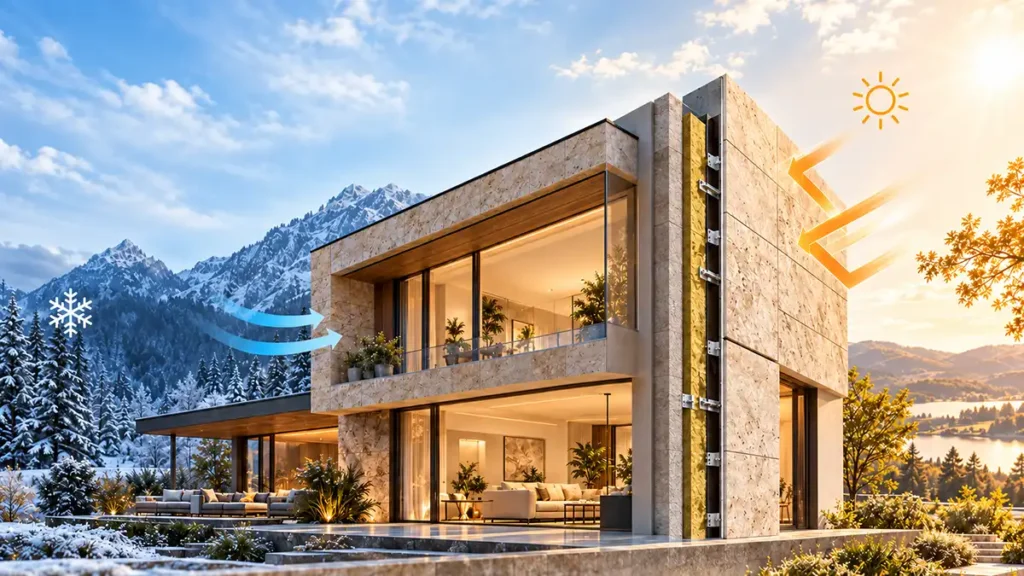
Where it does not help: stone is not an insulator
Stone conducts heat well, so it does not stop it from escaping from the house. The values below are approximate.
| Material | Approximate thermal conductivity (W/m·K) |
| Granite | 2.5–3.5 |
| Marble | 2.0–3.0 |
| Travertine / limestone | 1.3–2.3 |
| Mineral wool | 0.035–0.040 |
The conclusion: a stone cladding on the façade does not improve the energy class on its own. The performance comes from the insulation beneath it.
Practical applications
- Floor over underfloor heating. Stone transmits heat well from the pipes into the room and retains it after the system is switched off. It is one of the most efficient combinations for low-temperature heating (heat pump).
- Ventilated stone façade. The slabs are mechanically fixed, with an air gap behind them and insulation on the wall. The stone protects the insulation from rain and UV, and the air layer reduces façade heating in summer.
- Interior walls in sunny areas. A clad wall in direct sunlight works as a heat accumulator.
- Light-coloured terraces and paving. They reflect more solar radiation and heat up less than dark surfaces.
Frequently asked questions
Does natural stone provide thermal insulation? No. It has high thermal mass, but also high thermal conductivity. Insulation is done with dedicated materials.
Can stone be laid over underfloor heating? Yes, it is a very good combination, with suitable adhesive and joints and with a gradual start-up of the heating after installation.
What does a ventilated stone façade bring? Durable protection for the insulation, less heat transmitted to the interior in summer, and a long service life of the façade.
About PIATRAONLINE
PIATRAONLINE advises architects and designers in choosing natural stone for heated floors, façades and interior cladding, and delivers the material cut to size with complete installation. For architects and designers, samples and their transport are free of charge.
Request technical consultancy: via the website, email or WhatsApp.