


Choosing stone (by intended use)
Façades/plinth
How do I choose stone for façades, plinths, or fences
For these spaces, decorative natural stone is the most commonly used, since façades are key to a building’s look while also serving protective and thermal-insulation roles. For façade cladding, free-length split-face stone, panels, or standardized tiles with striking finishes are recommended. The choice of stone type is free, depending on each project. For public or large-scale projects, ventilated installation can also be chosen for the façade (ventilated façades are a practical solution common in urban settings, and define the “modern personality” of a new or renovated building, through large façades clad in composite materials. The advantage of this type of façade comes from using lightweight materials that don’t stress the building’s load-bearing structure, are durable, and are easy to maintain).
Panel cladding (e.g. 15 x 60 cm) has the advantage of a good look and quick, easy installation. Panels are 15 x 60 cm and are made of small natural stone pieces pre-assembled/glued and boxed. The resulting panel is glued in place using the “comb” adhesive technique, just like a regular tile. The main natural stone types used for façade panels are: marble, slate, quartzite. The adhesive used is a flexible type, with C1 adhesion.
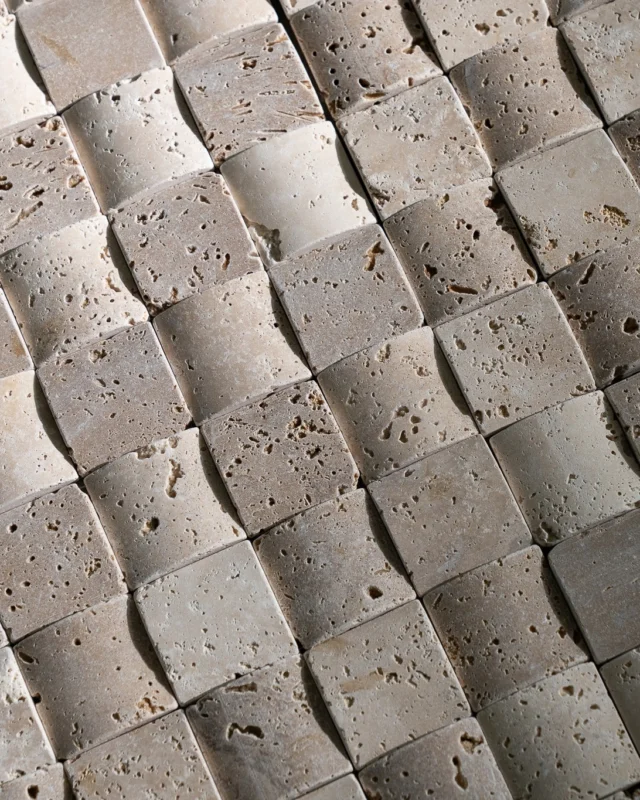
Free-length (LL) decorative stone cladding uses tiles from 2 cm to 25 cm wide, depending on the customer/project, and variable lengths. The effect is enhanced by special finishes, most often split-face. Installation is similar to standard-size tiles, with or without joints, depending on the customer. Façades with large tiles (e.g. 60 x 30 cm) can use C1 (normal-strength) or C2 (enhanced-performance) adhesives. They can be installed with or without joints, using low-water-absorption grout.
Polygonal stone cladding is usually done with wide joints (over 5 mm). Low-water-absorption grout is used.