


Choosing stone (by intended use)
Living rooms/kitchens/living spaces
How do I choose stone for living rooms and living spaces (living room, bedroom, hallway)
Cladding living spaces (living room, bedroom, hallway) with natural stone doesn’t call for special conditions. That’s why all stone types and finishes are acceptable. Tile size and thickness are also a matter of choice. Cladding on drywall partitions should be assessed based on the weight of the tile and adhesive, keeping in mind that a drywall wall can support around 50-60 kg/sqm (tile + adhesive). The only real factor is where it’s installed – floor or wall – with tile size and finish chosen accordingly (equivalent to R9). Special finishes (split-face, sandblasted, bush-hammered, etc.) should be avoided on floors, and heavy large-format tiles on walls should be installed on a metal frame.
A modern approach to wall cladding involves installing large-format tiles (half-slabs). This is done on suitable metal frames that are then concealed. Another striking cladding option is bookmatching, which highlights the symmetry of the pattern across two stone slabs installed side by side, joined together.
Adhesives used for cladding living spaces are standard types (C1 adhesion class), with no need for flexible adhesives (except for interior stairs). Cladding can be done with or without joints. Decorative polygonal stone cladding indoors is done with joints.
Choosing stone for indoor cladding in public spaces (offices) is based on durability under the given environmental conditions. As a result, any type of natural stone can be used: granite, marble, travertine, slate, limestone.
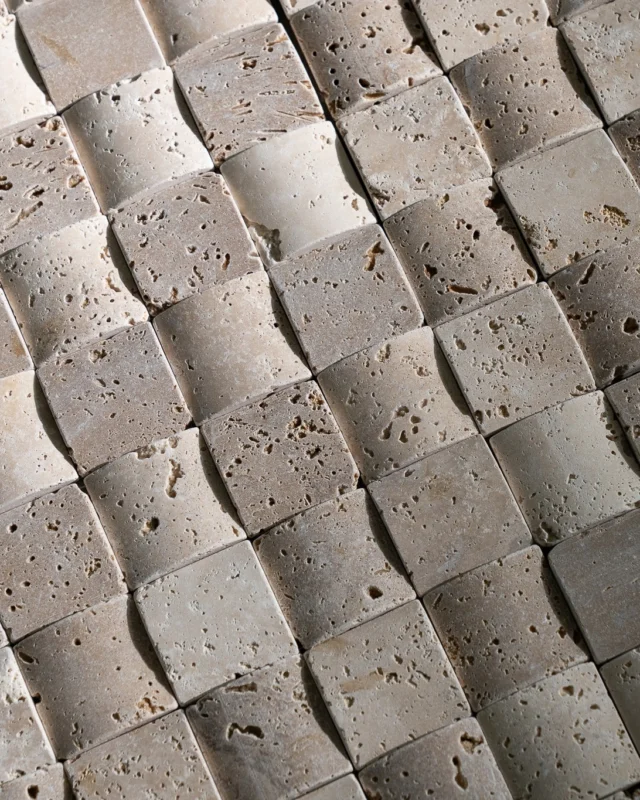
Indoor cladding with panels and mosaics is mainly used as an accent, and the installation method is comb-applied adhesive.
Flexible slate cladding is done using specific adhesives (Soudal), with a technique similar to hanging wallpaper.
How do you maintain natural stone cladding if you have pets
If you’re a pet owner, you know how much love a furry friend can bring into your daily life. Along with that love comes plenty of worries, including a fair amount of mess to clean up. However well trained our beloved pets are, it’s only a matter of time before an accident happens. And, however sheepish and apologetic they look afterward – enough to melt your heart – the stains that follow are hard to clean, can damage cladding, and can leave a bad smell in the house. Not to mention the scratches their claws leave on floors. In this article you’ll learn how to protect natural stone surfaces from the “attack” of household pets.
Do you know how much your four-legged friend’s urine can stain?
There are plenty of reasons not to like the stains pets leave on your living room floor. They look awful, they’re unhygienic, and they smell bad. Let’s also look at what effect urine can have on a surface. Urine is a natural product that changes state over time. When first released, urine has a pH between 5 and 6, so it’s mildly acidic. As it dries, it becomes alkaline, turning into a high-pH base (10-12), which can seriously damage both furniture and natural stone cladding. The salts in urine absorb moisture, and the more this happens, the stronger the smell becomes. Meanwhile, the stain is absorbed into the stone flooring, causing long-term damage. Calcareous rocks (marble, travertine, limestone, onyx) are more sensitive and deteriorate more easily. Trying to clean the stains with acidic detergents makes the damage worse.
Add to that the grease stains pets leave on surfaces along with dirt from their paws and fur, shed hair, or the unpleasant stains left when a poor dog or cat is sick, and you get a clear picture of what loving four-legged friends can put your surfaces through.
And what about scratches?
If you don’t keep their nails trimmed and let them run around joyfully on your slate floor, you’ll find that their love leaves a mark. A serious one, too, since slate is a hard rock, resistant to mechanical impact and stains, and can handle a lot of “wear” – but it doesn’t like having its surface attacked with sharp objects, even if they’re just your dog’s claws. Then it gets annoyed and scratches. Other surfaces, such as marble, travertine, or limestone, are less resistant to mechanical impact and can also scratch. So, however wonderful our beloved pets are, they can also cause some mischief. Let’s look at how to deal with the effects of living together.
How do you protect surfaces when you have pets
You can reduce scratches with Clear Wax, a neutral wax that repairs the surface as much as possible. If the floor is marble or travertine, you can also try a mechanical treatment, such as polishing or brushing, as appropriate. Results are good. Urine stains, however, are harder to remove, especially on untreated surfaces. If you catch it in time, quickly grab a clean cloth and wipe up the stain right away; Stonewash is a neutral detergent well suited for this. Or clean with Waxwash, which also has a pleasant scent. Otherwise, if your pet can still smell their urine, they’ll think that spot is the place to go when they need to, and will look for it again. And so on. To discourage this, get rid of the smells that tempt them off surfaces, avoiding the habit forming. If you didn’t catch it in time and the smell alerted you to the stain late, you can try removing it with specific detergents, such as MGP 1. The key, though, is prevention. That means having the surface prepared for when an accident happens. This is done by sealing with specific impregnators, chosen based on precise criteria such as the type of stone, its absorption level, and the age of the cladding.
Look for the right solutions on piatraonline.com, or visit the PIATRAONLINE location at Aleea Teișani 137A and discover how to clean and protect the natural stone in your home and garden.