


Choosing stone (by intended use)
Wet areas/bathrooms
How do I choose stone for cladding in wet areas (bathrooms, shower stalls, foundations, basements, terraces, public spaces, etc.)
Interior flooring (horizontal indoor cladding)
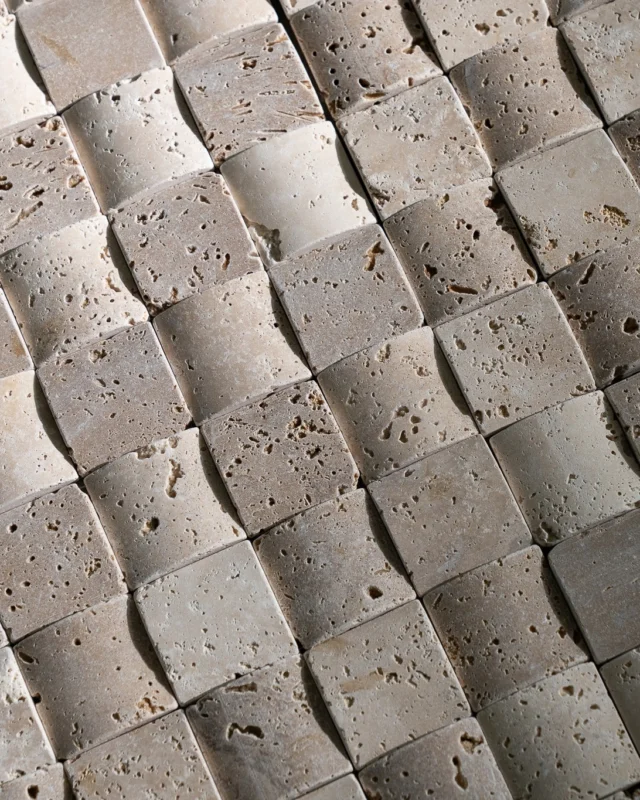
For flooring in wet areas, you can choose granite, marble, slate, or travertine tiles (less commonly sandstone or flamed granite) in various sizes. Thickness can range from 1-2 cm. Matte, brushed, or antiqued finishes are recommended, since they carry a lower slip risk. Special finishes (bush-hammered, sandblasted, split-face, and others) are impractical when it comes to maintaining indoor spaces.
For indoor flooring in public spaces, large-format tiles are chosen. Standard sizes (e.g. 60×30 cm and others) are also an option, and are more commonly used in private spaces. Small, square tiles are recommended for smaller bathrooms.
French pattern layouts are chosen for large surfaces, as are large-format tiles. Glossy finishes are easier to maintain but become slippery, while matte or non-glossy finishes are anti-slip but cost more to maintain. The equivalent slip-resistance standard is R10 (e.g. shared showers, garages, basements, etc.).
Panels aren’t recommended for flooring, while matte, polished, or antiqued mosaics are recommended for low-traffic flooring (private homes).
Walls (vertical indoor cladding)
For wall cladding in wet areas, substrate preparation and adhesive choice are essential, since adhesion issues can arise. In areas with persistent moisture and poor ventilation, there’s a risk of mold. Tiles of any size and finish can be used. A thickness of 1-2 cm is suitable/recommended. High-porosity natural stone (sandstone) should be avoided.
Choosing polished tiles is advantageous not just for looks but also because of lower maintenance costs. Wall cladding in public spaces should account for wall height and the possibility of condensation.