


About natural stone
Choosing stone by purpose
1. How do I choose stone for wet areas (bathrooms, shower stalls, foundations, basements, terraces, public spaces, etc.)
For floor or wall cladding you can choose granite, slate, marble, or travertine tiles in various sizes; the last two are also recommended for countertops. For flooring, an unpolished finish is recommended, since it prevents slipping. Cladding in wet areas must be sealed.
Recommendation: don’t forget waterproofing!
2. How do I choose stone for the kitchen
Floor tiles need to be resistant to traffic and stains, but also easy to clean and maintain. All low-water-absorption stones are recommended (metamorphic rocks – marble, slate; igneous rocks – granite; and certain travertine varieties). Finish: a polished finish is easy to maintain but can become slippery; a matte finish offers more safety but has somewhat higher maintenance costs. Walls can be clad with low-porosity stone. For the kitchen counter, polished granite is recommended if it’s used as a work surface, and marble, travertine, or slate if you’ll be eating at it.
Recommendation: use polished stone for a breakfast bar/counter overhang!
3. How do I choose stone for living spaces (living room, dining room, bedroom, hallway)
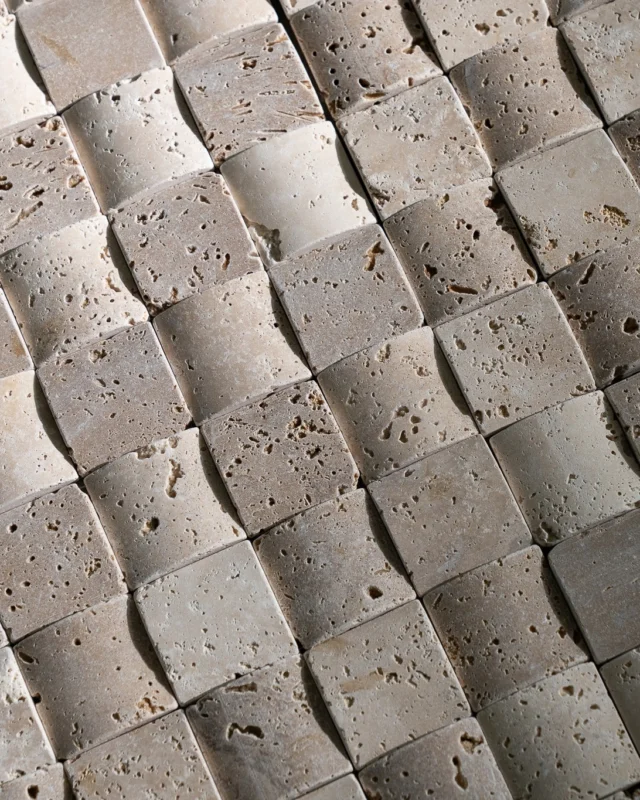
In living spaces, stone is installed as vertical and horizontal cladding, and as an accent. For flooring, larger tiles are recommended – more elegant and easier to maintain. Any natural stone can be used for flooring; the finish can be polished, matte, or brushed. For walls, marble and travertine are the most popular choices. Accents are created with special finishes (split-face, bush-hammered, antiqued, sandblasted) as well as mosaics. For striking effects, panels are recommended.
Recommendation: transform your living room with flexible slate!
4. How do I choose stone for a façade
There are 3 types of façades: solid stone masonry; concrete/brick masonry clad with stone; ventilated façades.
For exterior solid-stone walls, polygonal stone with irregular shapes and sizes is chosen. For cladding, marble, slate, and travertine are the most common choices, in free-length tiles or panels. The finish is usually special (split-face, bush-hammered, sandblasted, brushed). Decorative brick is also used. Ventilated façades use large tiles, mounted on metal frames or anchored directly to the wall. Any stone type with a low-porosity finish (marble, slate, granite) can be used. Sealing is needed at least on the exposed face.
Recommendation: use rectified tiles for ventilated façades!
5. How do I choose stone for outdoor paving
Outdoor paving is done with tiles of any natural stone, depending on traffic and environmental conditions. For pedestrian traffic, tiles starting at 1.5 cm thick are used; for heavier traffic, 3 cm thick stone is used. For vehicle traffic, granite, sandstone, or slate cobblestones are used, in variable thicknesses.
Recommendation: for heavy vehicle traffic, install cobblestones at least 10 cm thick!
6. How do I choose stone for a pool
Natural stone for pools can be granite, travertine, slate, limestone, marble, or sintered stone, as long as it has the lowest possible water absorption (e.g. granite 0.4-1.5%, marble 0.5-2%) and an unpolished finish (flamed, brushed, antiqued). Large tiles 1.5-2 cm thick are recommended.
Recommendation: don’t let water sit on the surface at the end of the day!
7. How do I choose stone for plinths
Natural stone plinths are strong and durable. Usually made from polygonal stone or free-length tiles. Any low-porosity type (granite, marble, slate, certain travertine varieties). If the plinth is built directly from natural stone, choose the one with the best compressive strength.
Recommendation: don’t forget waterproofing!
8. How do I choose stone for adjacent outdoor spaces (terraces, uncovered balconies)
Outdoor cladding is exposed to weather cycles. For flooring, any stone type at least 1.2 cm thick can be chosen, depending on traffic. The finish should be matte, flamed, brushed, or antiqued, and slip-resistant. For walls, any stone type and finish can be used. Sealing is recommended.
Recommendation: use only flexible adhesives for installation!
9. How do I choose stone for exposed flooring on pedestals
Exposed pedestal flooring is done with large square or rectangular tiles. One key factor is the number of pedestals needed. Example: a 60 sqm area (10 m x 6 m) using 60×60 cm flamed Rosa Porino granite needs 198 pedestals, while 60×40 cm flamed Padang Dark needs 288 pedestals. With 40×40 cm tiles it would be 256 pieces. So square tiles are more cost-effective than rectangular ones (depending on the number of pedestals needed).