


About natural stone
The Journey of Stone
From deep within the earth to your home, stone travels a long, demanding journey, revealing at times a breathtaking beauty, and at others properties of exceptional value. It all comes together in unique spaces, where the stone’s qualities and its looks blend into a beautiful whole.
But how does stone make this journey, becoming today’s most sustainable building material?
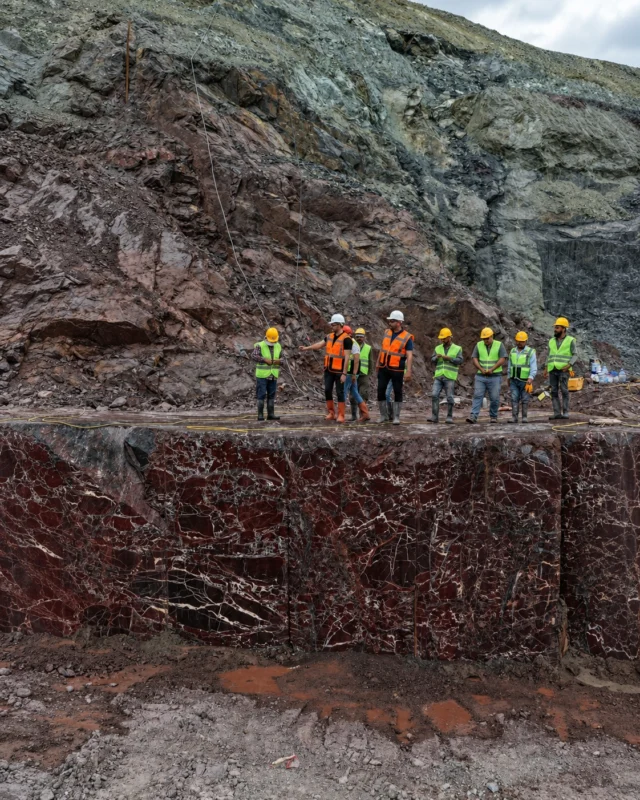
Picture first a mountain of marble, or granite, or travertine, or any other type of rock. From that mountain, skilled miners excavate and bring an immense block of stone into the light. The block usually has a shape close to a rectangular prism, with a base 2-3 m long and 1.5-2 m wide, and a height of up to about 1.5 meters. It can weigh several dozen tons, which means transporting it to processing centers is no easy task, and neither is loading, unloading, and handling it (cranes, gantries, and so on).
Once it arrives at a processing plant, the block is assessed for size, weight, veining, and any cracks or stains. Based on these criteria it’s graded, and the price of the block and its derived products is set according to that grade.
Next comes cutting the block. Large blocks are cut using “multiwire” technology (very strong diamond-coated cables), guided by process computers, under continuous jets of water for cooling. Cutting happens simultaneously, in a vertical plane, producing as many slabs as there are cables; this can take more than 8 hours. For smaller blocks with irregular faces, cutting machines with huge disc-shaped blades are used, along with a blade that cuts horizontally, producing “strips” of stone. Both technologies aim to use the whole block with maximum efficiency: “multiwire” for slabs, “block cutters” for tiles. Slabs are usually 1.5-3 cm thick and 1.8-2 m long (they can reach up to 2.90 m). Tiles are 0.9 to 3 cm thick, in sizes from 10×10 cm up to 120×60 cm or even larger.
The slabs’ journey continues with reinforcement, applying a mesh backing to one side (not required for every type of rock, only certain ones). The next step is applying a finish.
Here are a few of these finishes:
polishing – a glossy look, achieved by buffing.
honing – smoothing the surface with no shine; a matte final look.
antiquing – “aging” the stone (the patina of time).
bush-hammering – mechanical processing that creates an irregular texture, suited to outdoor installations or accents.
mechanical sandblasting – spraying sand under pressure; a smoother look than bush-hammering, with a uniform, irregular texture.
There are other finishes too: split-face, natural, brushed, chiseled, flamed, and more; combinations are also possible. Tiles can be rectified or have their edges processed.
After processing, the material moves to storage and preparation for delivery. Slabs are stored horizontally, on wooden supports, and shipped in containers. Tiles are stored and shipped in wooden crates. Slabs are transported secured in wooden frames, to prevent bending stress or vibration. Handling slabs requires professional lifting equipment. The mode of delivery (road, rail, sea) is chosen based on the destination. On arrival, containers are unloaded and the stone continues its journey to its final destination.
And so, in your living room, bathroom, or kitchen, or on your home’s façade, or on the terrace in your garden, the fascinating journey of stone comes to an end – a journey that began with a giant block broken free from an ancient mountain.